

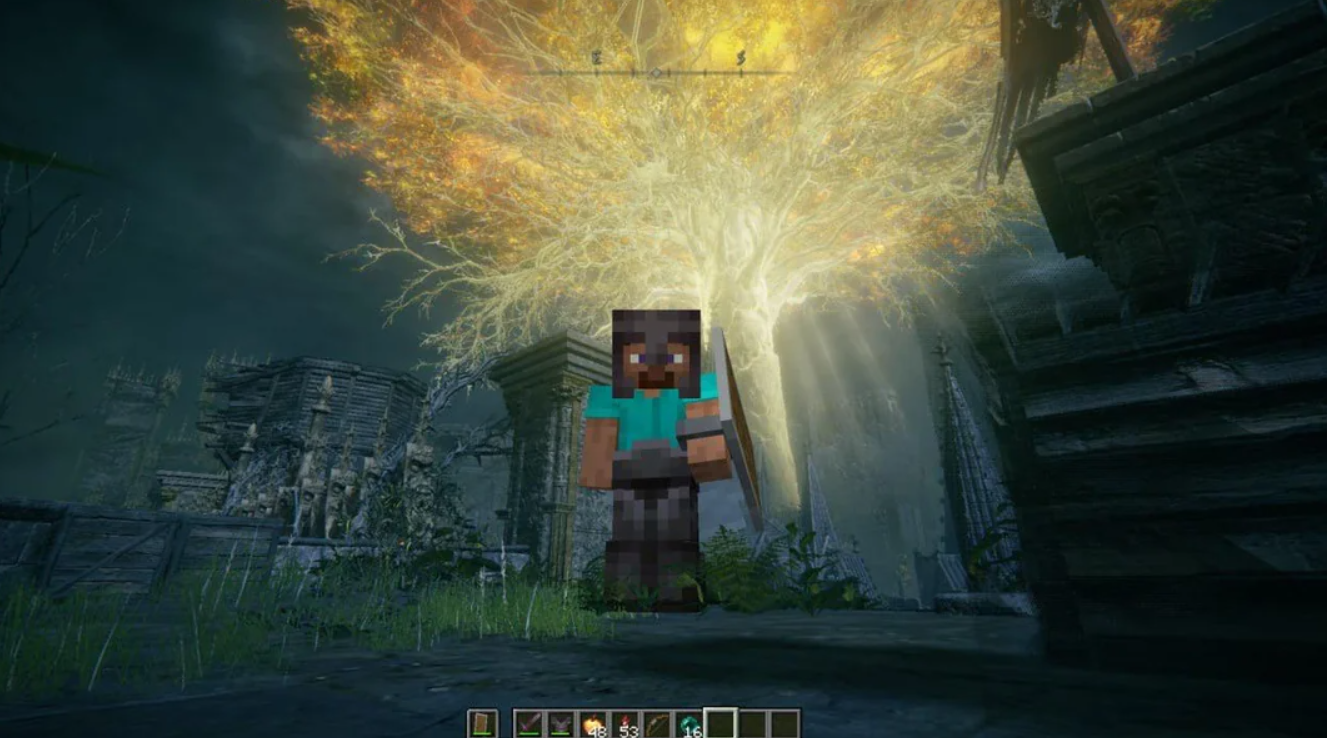
Games as platforms for other games is nothing new, but what’s changing is the scale and creativity of what players are recreating, from Call of Duty maps in Minecraft to Minecraft in Elden Ring. AI-assisted coding tools are making some of these feats more accessible.
More and more, modders aren’t just adding new characters, maps and textures to existing games. Some are bending their host games’ engines and gameplay systems well beyond what the original developers intended, sometimes fusing aspects of multiple games together, and in some cases attempting to recreate entire games from scratch inside other games.
Better tools also pose a question: just how far can mods take existing games?
How Do You Put One Game Inside Another?
It all depends on what kind of access the developer has to the innards of the game, and what they’re trying to recreate. Some mods recreate another title’s mechanics using their host game’s engine, for example, replicating a first-person shooter’s levels, guns, physics and controls in Minecraft.
But emulating or otherwise recreating an actual game is a step beyond that. Whether that’s through virtual machines or some other means of tricking a program into running in an environment it wasn’t designed for (which can be especially tricky if the game it’s being imported into wasn’t designed with importing other programs into it in mind), these recreations can be significantly more involved technically.
And again, some recreations stop at recreating a map, and that’s fine. But when you’re talking about the best examples of these, people are recreating working guns and enemies and movement mechanics, attempting to capture not just the look of a game, but its feel as well.
COD in Minecraft?
In one such example shared on Tom’s Hardware, developer Luckey Faraday shows off his recreation of Call of Duty: Black Ops 2’s multiplayer map, Hijacked, in Minecraft. Set on a luxury yacht, Hijacked is a relatively small map with plenty of routes and tight hallways for players to traverse. Faraday’s recreation apparently goes well beyond just the map, however, as it also features rendering, collision, bots, navigation, guns, etc., all running at around 45fps.

Minecraft Mechanics Into Elden Ring
Another example of experimentation can be seen with Tobyn Jacobs showing off his project to add Minecraft mechanics into Elden Ring. This means adding in building, crafting, inventory management and redstone mechanics.
There are a lot of Minecraft items included in this project with reports saying there are 1,600 items within it. However it will be best to check out the original demonstrations to see the full list of features. This is an interesting concept as the two games have very different styles.
Minecraft is all about collecting resources, crafting and changing the world. Whereas Elden Ring is about exploring, fighting and progressing through a well-made fantasy world. This means some work would be needed to add the mechanics.
To add building mechanics you need rules to add/remove blocks, crafting means having an inventory and recipes. Then you need to add redstone mechanics which involves logical thinking and interactions between items. All of this will need to work alongside the original game mechanics.
This is a good example of how creating mods can be like creating a game of its own. The creator is trying to add mechanics from another game into theirs.

Why Are They Doing This?
It can be quite a fun challenge to try and recreate a game within another. This means the creator will have to understand how the original game works and consider any technical limitations. They can also use an already popular game
This means they can use the already existing code for rendering, inputs, physics, animation and world interaction. They can then build onto this. For example something that could have been complicated to create in a new engine could be easier to create.
Games such as Minecraft are perfect for this as they are flexible and have a large modding community. Everything has a base to work from. The same can be said for other moddable games. Once the creator understands how the mechanics work they can begin to experiment with features that weren’t originally in the game.
Of course there are some limitations. They might run into limitations with the engine, have no access to the code, performance issues or incompatibility. Not everything will be playable. However it shows that what the game was intended for doesn’t always mean that’s all you can do with it.
How does AI help?
Artificial Intelligence is being used more and more to make complex mods easier.
AI coding can help you understand code you aren’t familiar with, generate functions, suggest solutions to programming errors and help convert code. This is great for indie developers as they may not know how everything in the game works.
Imagine if you wanted to recreate a combat system. You would need to add weapons, collision detection, animations, enemy movement and interactions. Using an AI assistant can help you create some base code, understand programming concepts and highlight potential issues.
Whilst it isn’t going to make it easy, it can make the repetitive tasks quicker and make it easier to understand unfamiliar programming issues.
AI can also help you understand existing code. When creating mods you are often using code created by others. Often the code isn’t well documented. Using tools to help you understand the code and suggest changes can make it easier to experiment.
An example of this can be seen with the reported Hijacked project. AI was used to help convert the previous code.
However, this does not mean it will create the game for you. Whilst it can generate code, you still need to test the code, figure out why things are failing, manage incompatibilities and ensure everything works together.
The generated code can cause issues, be inefficient and not compatible with the game. Complex projects can cause multiple systems to fail due to one error. Human input is required so, overall it is best to think of AI as an assistant.
Can AI Help With More Ambitious Mods?
The biggest benefit of using AI is that it can reduce the amount of specialist knowledge and repetitive tasks required to attempt ambitious projects.
If you have a good idea but aren’t too experienced with a certain language you can use AI to understand the code and create a base. If you are converting an older mod you can use AI to find old functions.
AI can also help with creating procedural assets, testing, documenting and converting existing systems. As tools improve it can make it easier for small teams to experiment with mechanics that would have taken a lot of time and knowledge before.
For example if you wanted to convert an older game or convert the mechanics to newer platforms you could use AI assisted tools to understand the old code and find what needs to change. This will still require a lot of testing especially if the original used hardware specific behaviours or undocumented features.
It can also be used to help with accessibility and preservation. Modders could use AI to investigate abandoned projects, preserve older mods or create alternative ways to play existing games.
Of course there are limitations. There will be technical limitations, tools available and permission issues with the original. AI can’t magically bypass engine limitations and not everything can be legally or practically converted.
Overall with well known engines, active modding communities and AI assisted programming it opens up more opportunities for indie developers.
Whilst the demonstrations are impressive there is a difference between showcasing some mechanics and having a full game.
Whilst the mod might have a playable map and basic movement it might not have stable multiplayer, advanced enemy mechanics or be stable enough to play for long periods of time. Just because it has some features shown in a short video doesn’t mean everything will work smoothly.
Performance can also be an issue. Adding complex mechanics can put extra strain on the game. Rendering, physics, AI and world interaction all need resources.
There can also be permission issues. Different games have different permissions for modding. Using copyrighted assets and creating unauthorised commercial projects can cause issues with intellectual property. AI can’t help with this.
Overall it is best to look at individual projects and see what has been shown.
What Next?
Game modding has always been an experimental thing. However with easy to use tools it is opening up new ways to create.
Instead of just recreating a well-known game there are more attempts to recreate the mechanics. This includes adding mechanics and combining features from games that weren’t intended to work together.
Using AI can speed up the process by helping you understand unfamiliar code, create a base and solve issues. Whilst it won’t remove the need to know how to program, test and creative decisions it can help more people try projects they wouldn’t have been able to.
The more interesting point is that the tools used to create and mod games are becoming easier to use. This means indie developers have more opportunities.
Whilst these projects are a mix of technical showcases and ambitious mods how significant they become depends on how far they can go.
However it shows that you can do more with an existing game. With a determined modder they can turn it into something that the original developers never intended.
Leave a Reply